Unlock Your Peak Performance: Mastering How to Get into the Flow State for Unstoppable Success
The Quest for Effortless Productivity
Picture this: a task that should take a mere 90 minutes stretches into an 8-hour marathon of frustration. Sounds familiar? It’s a common plight, but the good news is that there’s a neuroscientific key to unlocking your productivity potential. It’s called the flow state, and it’s not just for the elite; it’s accessible to everyone. Let’s dive into how to get into the flow state and harness this power for your benefit.
What is the flow state?

Flow state, also known simply as “flow,” is a psychological and physiological phenomenon where an individual becomes fully and completely absorbed in and deeply focused on an activity, leading to a heightened state of productivity and creativity. This mental state is characterized by a sense of fluidity between one’s body and mind, where time seems to distort, self-consciousness fades, and the activity becomes intrinsically rewarding.
The Discovery and Science of Flow

The concept of flow was first researched and named by Hungarian-American psychologist Mihaly Csikszentmihalyi in the 1970s. Csikszentmihalyi became fascinated with artists who would get lost in their work, often for hours at a time, to the point that they would disregard their need for food, water, and even sleep. This observation led him to study this phenomenon across various fields and activities, from athletes to chess players, leading to the identification of flow as a highly focused mental state conducive to productivity.
Csikszentmihalyi’s seminal work, “Flow: The Psychology of Optimal Experience,” outlines his theory that people are happiest when they are in a state of flow—a state of concentration or complete absorption with the activity at hand and the situation. It is a state in which people are so involved totally immersed in an activity that nothing else seems to matter.
The science behind flow has been further explored in neurobiology, which explains that during flow states, there is a cascade of neurochemicals in the brain, including dopamine, norepinephrine, endorphins, anandamide, and serotonin. These chemicals not only boost mood and motivation but also enhance performance and learning. Additionally, flow is associated with the brain entering a state of transient hypofrontality, where the prefrontal cortex temporarily deactivates, reducing feelings of self-doubt and allowing for more creative and less inhibited thought processes.
Flow is not just a fleeting experience but a skill that can be cultivated. Research has shown that individuals who experience flow regularly tend to have higher levels of overall happiness and satisfaction in life. They also tend to be more productive and achieve higher levels of performance in their respective fields.
By understanding the origins and mechanisms of flow, we can better appreciate its power and learn how to harness it in our personal and professional lives. The discovery of flow has had a profound impact on positive psychology and has provided a framework for exploring the depths of human potential, personal control, and performance.
Reasons You Need to Know How to Get Into The Flow State

Understanding how to enter the flow state is not just about improving productivity; it’s about enhancing the quality of your life. Here’s why mastering the art of achieving flow is so crucial:
Peak Performance: When in flow, your performance in any activity can significantly improve. Whether you’re coding, writing, creating art, or solving complex problems, flow can help you do it better and faster.
Learning and Skill Development: The flow state accelerates learning. The intense focus allows for deeper immersion in the task, which can lead to improved skills and mastery over time.
Increased Creativity: Flow is often accompanied by a surge in creativity. It allows for novel connections and ideas to emerge, which is invaluable in any creative or problem-solving endeavor.
Enhanced Well-Being: Flow experiences contribute to overall well-being. They provide a sense of fulfillment and can be a source of joy and satisfaction in one’s work and hobbies.
Stress Reduction: Engaging in flow can reduce stress by shifting focus away from worries and anxieties to the task at hand, providing a break from the stressors of everyday life.
Greater Intrinsic Motivation: Flow fosters intrinsic motivation, where the activity itself becomes the reward. This can lead to a more sustainable and self-reinforcing work ethic.
Improved Mental Health: Regularly experiencing flow can have a positive impact on mental health, reducing symptoms of depression and anxiety and promoting a sense of competence and achievement.
Better Emotional Regulation: The concentration required to maintain flow can help develop a stronger command over one’s emotions, leading to better emotional stability and resilience.
By integrating flow into your life, you set the stage for these benefits to manifest. It’s not just about the immediate gratification of losing yourself in a task, but about the long-term advantages that come with regularly tapping into this powerful state.
Step-by-Step Instructions on How to Enter The Flow State

Entering the flow state is akin to a dancer gliding effortlessly across the dance floor; it requires grace, precision, and an understanding of rhythm. To achieve this state of peak productivity, where your work feels less like a chore and more like a natural extension of your being, follow these detailed steps, grounded in the four pillars of flow.
Identifying and Eliminating Flow Blockers

The first step is to identify and eliminate flow blockers. These are the distractions and stressors that prevent you from entering a state of deep work. Your digital devices, with their endless notifications, are often the biggest culprits. To counter this, establish a ‘flow before phone’ routine. Commit to a solid block of focused work on your most important or challenging task before you even think about checking your phone. This might mean placing your phone in another room, turning it off, or using apps that limit your access during work hours. The key is to create an environment where you can work undisturbed.
Enhancing Flow Proneness
Next, enhance your flow-proneness. This is your natural tendency to slip into flow. One potent method is to align your work with your circadian rhythms. Start your day with the most challenging tasks when your brain is fresh. The quiet of the morning is often when your mind is most receptive to entering flow. If you’re not a morning person, identify the times when you feel most alert and try to schedule your demanding tasks during these periods.
Activating Flow Triggers

Activating flow triggers is crucial. These triggers are specific conditions that lead you into the flow state. They include having clear goals for what you want to accomplish during your work session, receiving immediate feedback on your performance, and ensuring a balance between the challenge of the task at hand and your own skill level. To apply this, break down large projects into smaller tasks with clear, achievable goals. Seek out tasks that challenge you but are still within your ability to complete. This might mean adjusting the scope of the work to match your current skill set or taking on new learning opportunities to expand your capabilities.
Navigating the Flow Cycle
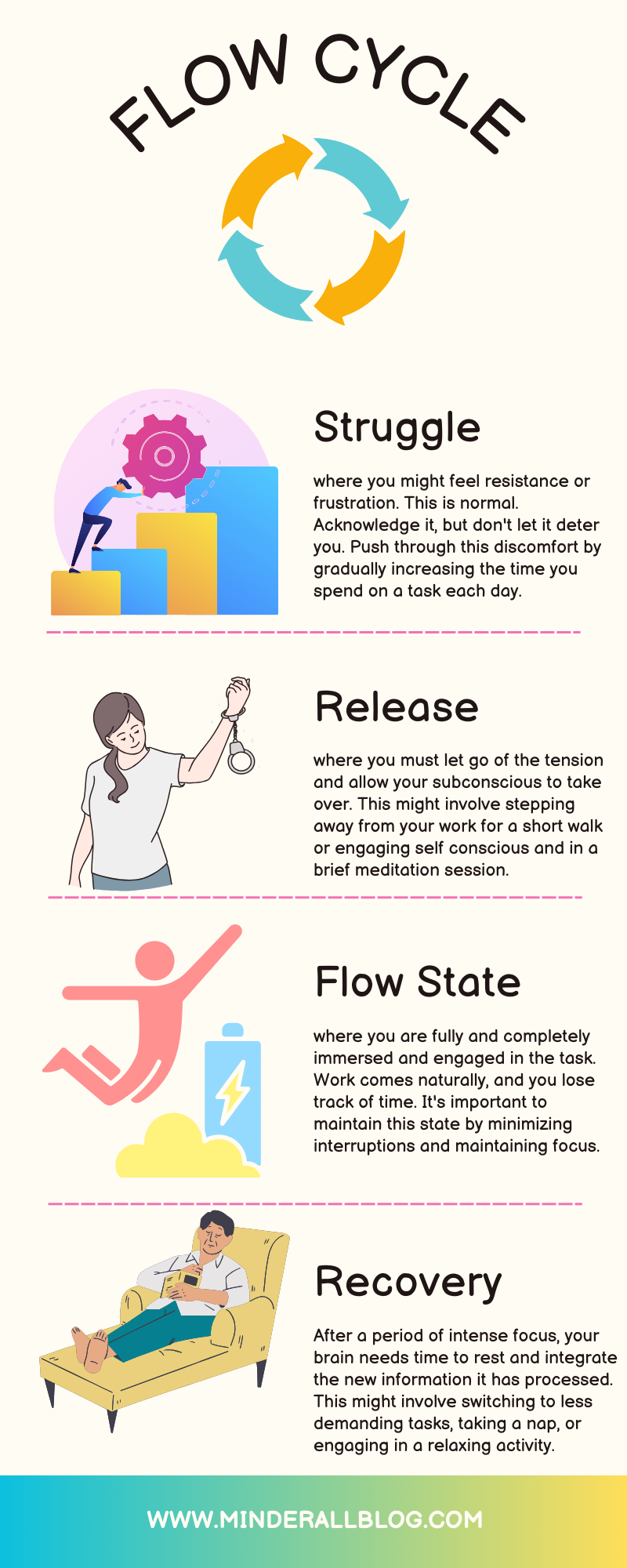
Understanding and navigating the flow cycle is the final piece of the puzzle. The cycle begins with the struggle phase, where you might feel resistance or frustration. This is normal. Acknowledge it, but don’t let it deter you. Push through this discomfort by gradually increasing the time you spend on a task each day. This could be as simple as working for an additional five minutes before taking a break.
After the struggle comes the release phase, where you must let go of the tension and allow your subconscious to take over. This might involve stepping away from your work for a short walk or engaging self conscious and in a brief meditation session.
Following release, you enter the flow state, where you are fully and completely immersed and engaged in the task. Work comes naturally, and you lose track of time. It’s important to maintain this state by minimizing interruptions and maintaining focus.
Finally, there’s the recovery phase. After a period of intense focus, your brain needs time to rest and integrate the new information it has processed. This might involve switching to less demanding tasks, taking a nap, or engaging in a relaxing activity.
Unique Tip

Incorporating the concept of the flow cycle into your daily routine can be a transformative practice, and setting six different alarm clocks throughout the day can serve as a powerful reinforcement of this ritual. Here’s how you can expand on the flow research with step-by-step instructions to enter the flow state with this method:
Identify Your Domino Habit: Determine the one habit that, when executed, makes the rest of your day fall into place. This could be anything from a morning meditation to a specific work routine.
Map Out Temporal Landmarks: Reverse-engineer your day to identify the key moments that lead up to your domino habit. These are your temporal landmarks, the critical points that set the stage for your habit.
Set Six Alarms as Hinges: Use your phone or alarm clock to set six alarms that correspond to your temporal landmarks. These alarms act as hinges, pivotal moments that signal when to shift activities to stay on track.
Morning Wake-Up: Your first alarm is your wake-up call. This is when you initiate your day with an activity that primes you for flow, such as exercise or a focused work session.
Mid-Morning Reboot: Set a second alarm for a mid-morning reboot. This could be a short walk, a meditation session, or a few minutes of deep breathing to reset your focus.
Afternoon Transition: Your third alarm marks the transition from morning work to afternoon tasks. It’s a reminder to evaluate your progress and adjust your focus if necessary.
Evening Wind-Down: The fourth alarm signals the beginning of your evening routine. This is when you start to wind down work activities and begin personal or family time.
Dinner Time: An alarm for dinner helps you maintain a consistent eating schedule, which is important for regulating your body’s clock.
Bedtime Preparation: The final alarm reminds you to start your bedtime routine, ensuring you get enough rest to wake up refreshed and ready to enter the flow state again the next day.
By adhering to these alarms, you create a structured flow experience each day that naturally leads to your domino habit. Each alarm is a nudge, a gentle push towards the next phase of your day, ensuring that you maintain the momentum needed to stay in a state conducive to flow.
Remember, the key to this system is not just the alarms themselves, but the actions they prompt you to take. They serve as reminders to engage in behaviors that support your flow state, creating a rhythm to trigger flow throughout your day that becomes as natural and automatic as the ticking of a clock. This method harnesses the power of time to foster flawless behavioral consistency, making self-mastery at every level not just a possibility but an inevitability.
By meticulously applying these steps, you can create the optimal conditions for flow. It’s not about forcing productivity; it’s about setting the stage for it to emerge naturally. With practice, entering the flow state can become a regular part of your work life, leading to increased satisfaction and outstanding results.
Key Considerations For Successfully Entering Flow State

1. Clear Goals and Immediate Feedback
To harness the power of flow, start with crystal-clear objectives. Whether you’re coding a new software feature or crafting a compelling piece of writing, knowing your end goal is essential. This clarity allows for immediate feedback on your progress, keeping you aligned and engaged.
2. Challenge-Skills Balance
Engage in tasks that hit the sweet spot between your current abilities and the challenge they present. This equilibrium is the playground of productivity, where tasks are neither too daunting nor too mundane, allowing your confidence and interest to peak.
3. Distraction-Free Environment
Craft a workspace that’s a fortress against interruptions. This means silencing notifications, using tools to block digital distractions, and setting boundaries with those around you. A serene environment is fertile ground for flow.
4. Flow Triggers and Proneness
Integrate activities into your routine that naturally propel you towards flow. This could be a morning meditation, a pre-work ritual, or a specific soundtrack that cues your brain into deep work mode. Cultivate a personal toolkit of triggers that elevate your flow-proneness.
5. Mindfulness and Emotional Regulation
Flow requires a present, focused mind. Techniques like mindfulness can train your brain to stay in the present moment, while emotional regulation ensures that anxiety or stress doesn’t derail your concentration. Embrace practices that foster a calm, centered state of being.
6. Task Persistence and Attention Span
Developing a robust attention span is like building a muscle. Gradually increase the time you spend on focused work, resisting the urge to give in to distractions. This persistence is the bedrock upon which flow is built.
7. Flow Cycle Awareness
Understand the flow cycle: from the initial struggle to the release, into the flow, and through to the recovery phase. Recognize that not every moment will feel effortless and that the struggle is part of the process. Embrace it, and know that it’s leading you towards the flow state.
8. Physical and Mental Well-being
Your physical state directly impacts your ability to enter flow. Regular exercise, adequate sleep, and proper nutrition are not just good for your health; they prime your brain for peak performance.
9. Positive Psychology and Growth Mindset
Adopt a growth mindset that sees challenges as opportunities for development. Positive psychology emphasizes the importance of a positive attitude and resilience, which are conducive to entering and maintaining flow.
10. Rituals and Temporal Landmarks
Establish rituals that signal to your brain that it’s time to focus. Use temporal landmarks throughout your day to transition smoothly between different modes of work and rest, ensuring that each phase of your day contributes to your overall productivity.
By weaving these key factors and considerations into your daily routine, you can create a conducive environment for flow, enabling you to tap into heightened creativity, increased well-being, and enhanced performance. Remember, accessing flow is a skill that can be cultivated with intention and practice.
Taking it to the Next Level: How to Enhance Your Flow State

If you’re committed to not just entering the flow state but truly mastering every aspect of your life, it’s time to consider elevating your approach. Imagine a life where peak performance is not an occasional occurrence but a consistent reality. Every day, you’re not just living but thriving, pushing the boundaries of what you thought possible.
Embrace the Masterclass on Life Mastery
For those who are serious about taking their lives to the next level, we have something special for you. We’re talking about an exclusive masterclass on life mastery that’s designed to help you unlock your full potential. This isn’t just another course; it’s a transformative experience that will equip you with the strategies, techniques, and mindset shifts necessary to excel.
Why this masterclass?
This masterclass is the culmination of years of research, experimentation, and proven results. It’s tailored for individuals who are not content with the status quo and are eager to embrace the greatness within them. Here’s what you can expect:
Strategies That Work: Learn from the best in the field with strategies that have been tested and refined for maximum effectiveness.
Techniques for Consistency: Discover techniques that will help you maintain a high level of performance consistently, not just in spurts.
Mindset for Success: Cultivate a mindset that not only seeks success but also sustains it through challenges and setbacks.
What will you gain?
By joining this masterclass, you’ll gain access to a wealth of knowledge that can transform your daily habits, your work, and your personal life. You’ll learn how to:
Set and Achieve Ambitious Goals: Break down your biggest aspirations into actionable steps.
Harness the Power of Habits: Build habits that align with your life’s vision and purpose.
Navigate Life’s Challenges: Develop resilience to overcome obstacles and use them as stepping stones.
Live Intentionally: Make every day count by living with intention and focus.
If you’re interested in getting the most out of your life and learning the great strategies and techniques to get there, this masterclass is for you. It’s an investment in yourself that can pay dividends for the rest of your life. Don’t let another day pass by where you’re not moving towards the life you deserve.
Take the first step towards life mastery. Join us in this masterclass and transform the way you live, work, and play. It’s time to unlock your potential and experience what it truly means to thrive.
[Click here to sign up for the Masterclass on Life Mastery and start your journey today!]

Join The Masterclass!
“Unlock Your Extraordinary Potential with Our Exclusive Masterclass
Embark on a transformative journey with our unique Masterclass, designed to unleash your inner greatness and guide you towards a life of continuous personal growth and success. Here’s what you can expect:
- Experience the 3-Minute Conscious Self Meditation: Delve into the world of billionaires with a powerful meditation technique that unlocks intuition and paves your instinctive path to success. All you need is three minutes and a quiet space to experience this life-changing exercise.
- Life’s 3 Big Pillars: A Framework for Flow: Learn our revolutionary framework to make personal growth a daily, subconscious, intuitive, and automatic process. Transform your life by integrating these pillars into your daily routine.
- Master Your Emotional States: Gain access to a method developed by Stanford University for mastering emotional states with ease. While others pay up to $16,000 for this knowledge, we’re offering it to you for free.
- Permanently Accelerate Your Transformation: Discover the secrets to supercharging your personal growth journey. Experience remarkable changes and extraordinary growth that will redefine your life.
By the end of this Masterclass, you’ll be equipped with the tools and techniques to automate your personal growth and unlock your extraordinary potential.
Don’t miss this opportunity to transform your life. Enroll now and start your journey to a more successful, intuitive, and fulfilling life!“
Alternatives to Entering Flow State
Not every task will lead to flow. For those, try structured breaks or switching up your tasks. Collaborative work and varied activities can also stimulate productivity without necessarily entering the flow.
Wrapping Up and My Experience With Flow State
Flow state is more than a productivity hack; it’s a way of life. By understanding the four pillars of flow, you can unlock a level of productivity and satisfaction in your work that you may have thought was reserved for geniuses and athletes. But it’s there for you, too. So, are you ready to get into a flow now?
By following these steps and understanding the pillars of flow, you can transform your workday from a slog into a seamless and enjoyable journey. It’s not about working harder; it’s about working smarter and aligning with your brain’s natural tendencies to achieve greatness. Welcome to the flow state—your path to becoming effortlessly productive.